
Tokenocracy
AI has never been cheaper. That's exactly why it's about to get expensive.

In April 2026, Uber ran out of its entire 2026 AI budget for coding tools. Not over budget. Out. Four months in. Weeks later, Microsoft started pulling Claude Code from thousands of its own engineers. Neither company was cutting back on AI. They were drowning in how much they loved it.
| Uber | Microsoft (Experiences & Devices) | |
|---|---|---|
| What happened | Burned its full-year 2026 AI coding budget in four months | Cancelling most internal Claude Code licenses by June 30 |
| Why | Adoption went 32% → ~95% of engineers; heavy users hit ~$2,000/month | Token spend blew through the team's annual budget; the tool got too popular |
| The lesson | Cheap per token is not cheap in total | Even a cash-rich giant flinched at the bill |
Microsoft didn't "ban Claude": the same month, it joined Nvidia in a multibillion-dollar bet on Anthropic and put Claude on Azure. It killed one expensive internal tool, not the model. Still, two of the most sophisticated companies on earth looked at their AI bill and flinched. By every headline measure, AI has never been cheaper.
Cheaper, and nobody can afford it
GPT-4 launched in 2023 at about $30 per million input tokens. Today a model that matches it costs around $2.50, and the budget tier is near ten cents, a 99% collapse in three years, with quality rising the whole way. Andreessen Horowitz calls it "LLMflation": for equal performance, inference cost falls about 10x a year.
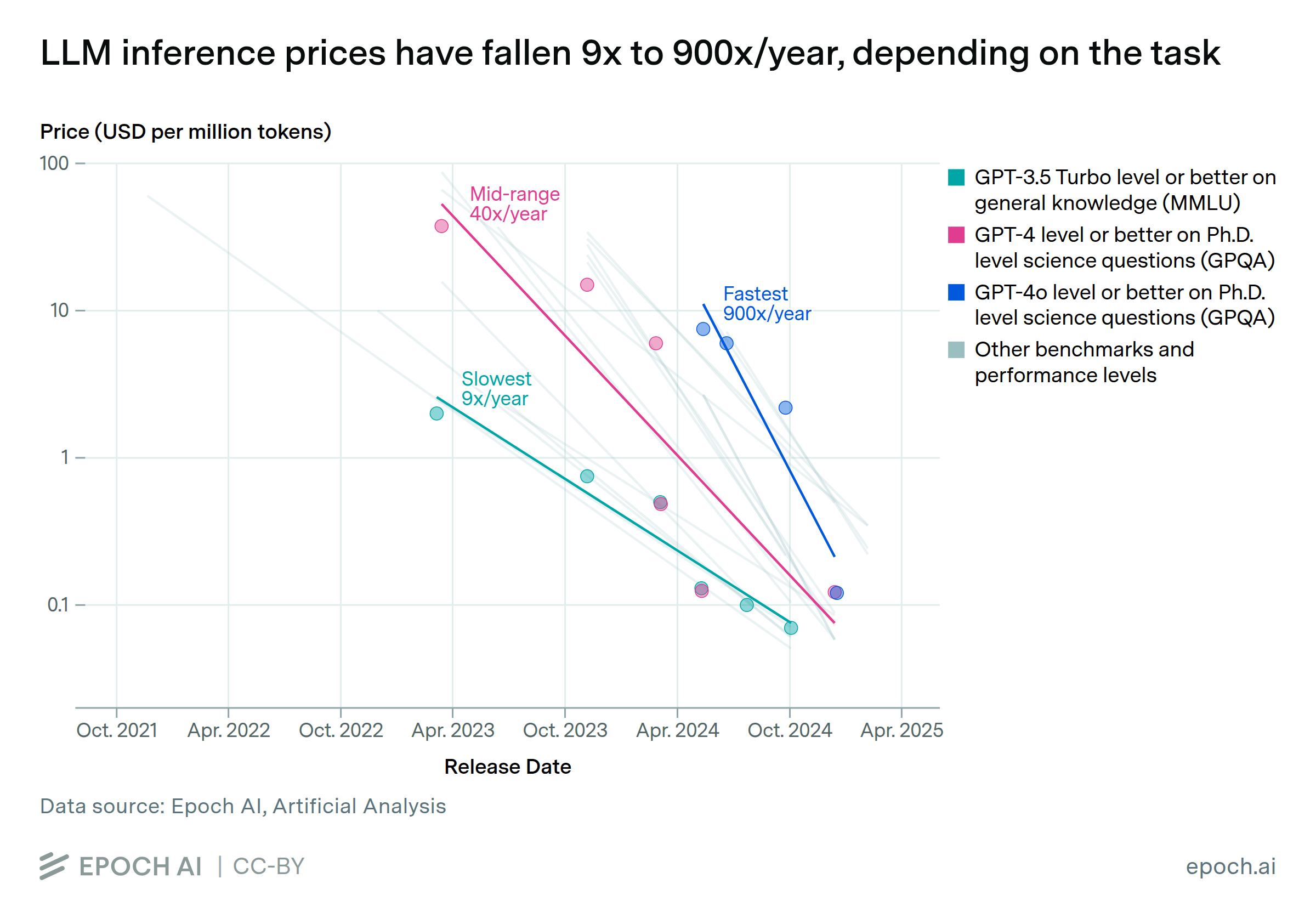
So how does a 99% price drop coexist with Uber running dry in four months? The oldest trick in economics: the Jevons paradox. Make something useful cheaper and we don't pocket the savings, we use far more of it. Reasoning models think for tens of thousands of tokens. Agents loop for hours. Prompts swallow whole codebases.
Cheaper tokens didn't shrink the bill. They detonated demand.
| Going down | Going up |
|---|---|
| Token price: −99% in three years (~10x/year) | AI agent software spend: $86.4B → ~$207B, +139% in one year (Gartner) |
| Energy per AI task: falling at record speed (IEA) | Data-centre electricity: on track to double by 2030 (IEA) |
Costs climb even as the per-unit price falls.
The race, and the graveyard
The pressure is producing real innovation. Money and talent now point at one goal, making AI radically cheaper to run: mixture-of-experts models, quantization, distillation, caching, custom inference chips, and the boldest front of all, rewriting the math itself.
The quadratic tax
One idea explains that last front, and it's simpler than it sounds. Today's models use attention: to read your input, every token compares itself to every other token. With n tokens, that's about n × n comparisons. Double the input, quadruple the work. That's quadratic scaling, O(n²), the red curve below. Fine at a thousand tokens; murderous at a million, where cost bends almost straight up. A subquadratic model rebuilds attention so cost grows in a near-straight line, O(n), the green curve. Double the input, double the work, not quadruple. Same understanding, but long inputs stop exploding the bill.
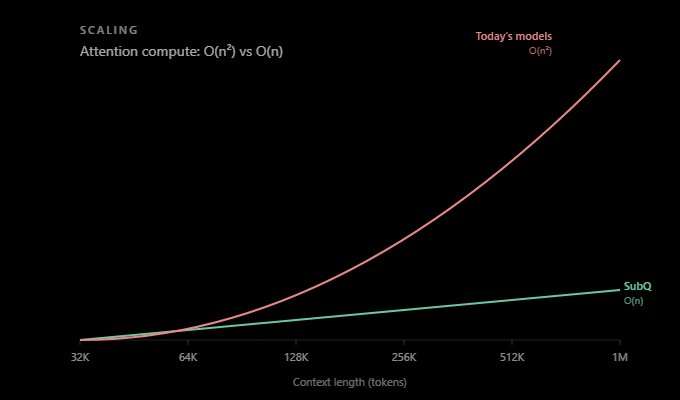
The whole bet, in one picture: keep the green line flat as context grows into the millions. Source: Subquadratic (subq.ai).
That's the prize Subquadratic is chasing: SubQ, a 12-million-token window at a fifth of frontier cost. It's neither alone nor first.
| Player | Approach | Headline claim | Honest status |
|---|---|---|---|
| Subquadratic (SubQ) | Subquadratic sparse attention | 12M-token context, ~1/5 frontier cost | Private beta, no paper, unverified |
| Cartesia | Mamba-lineage state-space models | Efficient long-context models | Shipping, research-stage |
| DeepSeek | Sparse attention | Cheaper long context | In production models |
| Moonshot (Kimi Linear) | Linear attention | Subquadratic scaling | In production models |
| Magic.dev | Long-term memory (LTM-2) | 100M tokens, ~1,000x efficiency | Raised ~$500M in 2024, then went quiet |
| Mamba / RWKV / Hyena / RetNet | Various subquadratic | Linear scaling | The "graveyard": fine at small scale, faltered at the frontier |
Believe the direction, not the press release. In a field this funded, the cost curve will keep cracking. The real question is what happens if it works.
One floor down, nothing is cheap
Software runs on chips, in buildings, drawing power off a grid. Down there, prices move the other way:
Capital: the five largest tech companies' capex blew past $400 billion in 2025 and is set to rise another 75% in 2026, almost all AI infrastructure.
Power: the IEA reports data-centre electricity grew 17% in 2025, and AI-focused centres surged 50%, against 3% for global demand. Gartner projects power shortages could throttle 40% of AI data centers by 2027.
Chips: grid connections take years, transformers have multi-year lead times, and a CNAS report states flatly that the leading AI companies cannot get enough silicon.
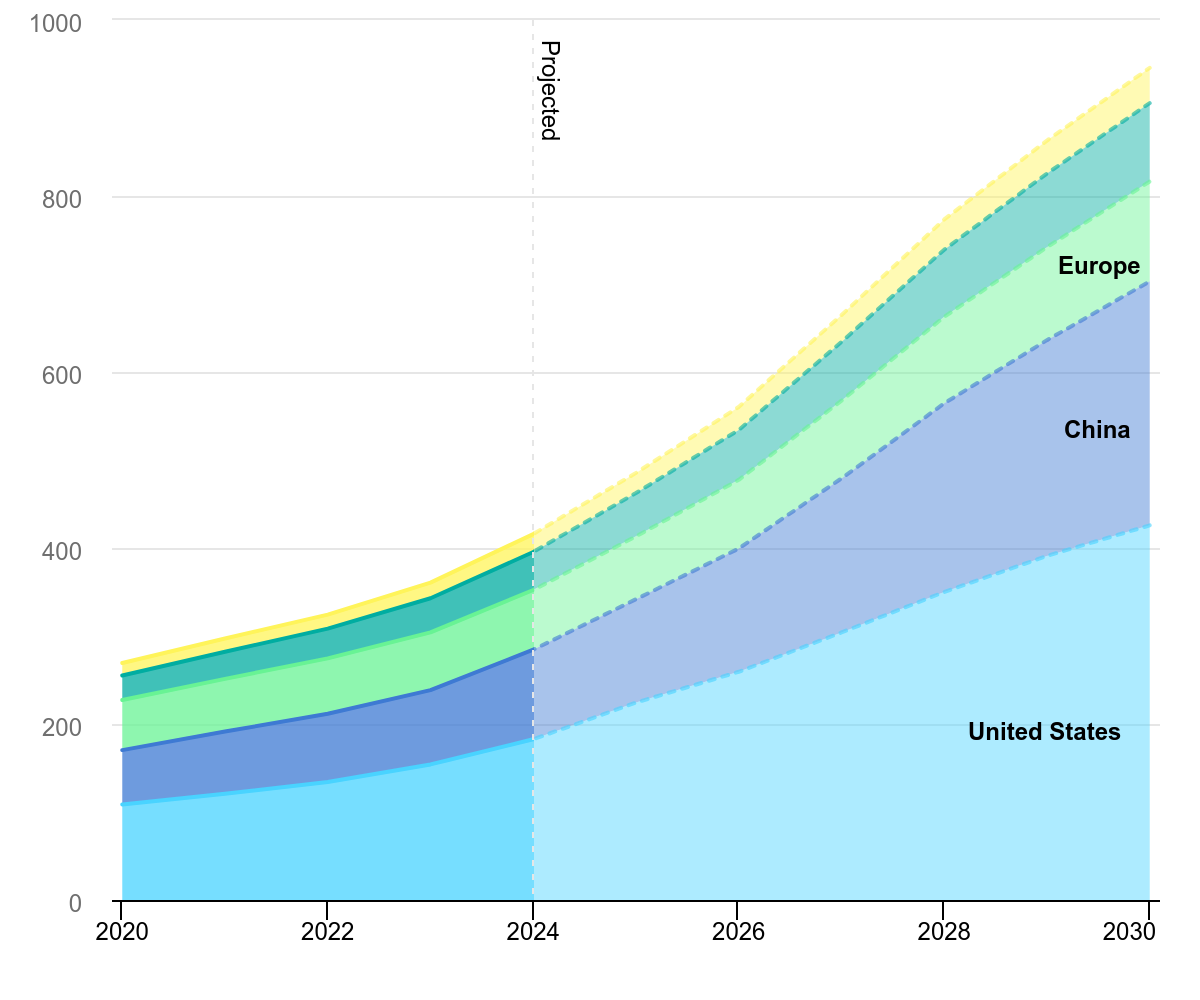
IEA (2025), Global data centre electricity consumption, by equipment, Base Case, 2020-2030, IEA, Paris https://www.iea.org/data-and-statistics/charts/global-data-centre-electricity-consumption-by-equipment-base-case-2020-2030, Licence: CC BY 4.0
A split-level economy. Upstairs, the price of intelligence is in free fall. Downstairs, the power and silicon it burns get dearer, and their supply is gated by physics and lead times measured in years.
The breakthrough makes it worse
Here is the counterintuitive part. Say the skeptics are wrong and someone, SubQ or the next contender, delivers cheap, frontier-grade long context. The instinct: more efficient models, less compute, crisis averted. Efficiency has never worked that way.
The IEA spells it out. Energy per AI task is falling fast, at a rate it calls unprecedented in energy history, and it still expects data-centre electricity to double by 2030, with AI-specific demand tripling. Efficiency per task up, total consumption exploding, at the same time. Jevons at civilizational scale.
A real SubQ pours fuel on that fire. Twelve-million-token contexts unlock applications nobody attempts today, agents that never forget, systems that swallow entire archives in one pass, each one new demand summoned by the cheapness meant to save compute. A genuine breakthrough wouldn't push the power and chip walls back. It would pull them closer.
The consultant's playbook
If you advise companies on this, I do, the conclusions write themselves, and almost none involve chasing the cheapest token.
Don't re-architect on a private-beta promise. SubQ is unverified and gated. Build model- and architecture-agnostic systems so you can swap in a cheaper long-context engine the day it's proven. Buy optionality, not hype.
Treat token cost as a managed variable, not a flat line. Uber's COO admitted he couldn't connect surging AI spend to measurable gains. Design against that: per-task budgets, monitoring, defensible ROI. Anthropic's shift to per-token metering for agents from June 15 says the cheap, predictable era is already ending at the edges.
Watch where the moat moves. If long context goes cheap, clever retrieval stops being a differentiator. What's left is your proprietary data and its governance, and, one floor down, access to power and compute.
The scarce resource is migrating from software, where it's cheap, to power and silicon, where it isn't.
Then the bill comes due
The token-price collapse is teaching everyone, people, startups, Uber, governments, to treat AI as a near-free, ever-cheapening utility, and to wire deep dependence into how they work. Sam Altman describes the goal as intelligence sold on a meter, like electricity or water.
Look harder at that metaphor. We meter electricity and water because they are finite, and we ration or reprice them when demand outruns supply. That is the collision being built. Demand climbs without a ceiling, juiced by falling prices and, maybe, by real breakthroughs. Supply, power and chips, crawls. Macroeconomics is blunt: surging demand against a supply that cannot keep up does not end in permanent abundance. It ends in rationing, or repricing, or both.
Welcome to the tokenocracy: a world that runs on the price of a token. The catch is that the token answers to something it cannot out-argue, electricity and silicon. Whether SubQ is real or vapor, the dependence we are wiring in rests on the most supply-constrained corner of the economy. Uber and Microsoft were the warning shot, they could absorb the bill and flinched anyway.
Two numbers decide everything. The price of a token, which keeps falling. And the price of the power and chips beneath it, which decides whether the first can keep falling at all. A breakthrough upstairs only makes the floor downstairs matter more.
A note from the field. I run into this in my own consulting work. Pricing agent-based solutions on Microsoft 365 Copilot is hard, hard enough that even Microsoft, as we saw, gets caught out by its own agent bills and keeps adjusting how the tools are licensed and metered. For those of us quoting clients from the outside, estimating what an agent will cost once people actually start using it is close to rolling a dice: the figure depends entirely on consumption nobody can see in advance. That is this whole essay compressed into a single line on a single proposal. When the unit is a token and usage is open-ended, "how much will this cost?" stops having a fixed answer, for the client, for the consultant, and apparently for Microsoft too.
Sources
Uber exhausts 2026 AI budget; Altman "utility on a meter"; Gartner $207B agent spend — Fortune: https://fortune.com/2026/05/26/uber-coo-ai-spending-tokens-claude-code/
Microsoft cancels internal Claude Code licenses (with nuance) — eCorpIT: https://ecorpit.com/microsoft-uber-claude-code-token-cost-2026/
"LLMflation," 10x/year inference cost decline — a16z: https://a16z.com/llmflation-llm-inference-cost/
LLM inference price trends — Epoch AI: https://epoch.ai/data-insights/llm-inference-price-trends
By 2030, inference >90% cheaper than 2025 — Gartner: https://www.gartner.com/en/newsroom/press-releases/2026-03-25-gartner-predicts-that-by-2030-performing-inference-on-an-llm-with-1-trillion-parameters-will-cost-genai-providers-over-90-percent-less-than-in-2025
SubQ launch — Subquadratic: https://subq.ai/introducing-subq
SubQ skepticism and Magic.dev parallel — VentureBeat: https://venturebeat.com/technology/miami-startup-subquadratic-claims-1-000x-ai-efficiency-gain-with-subq-model-researchers-demand-independent-proof
Data-centre electricity surge; hyperscaler capex >$400B (+75% in 2026) — IEA: https://www.iea.org/news/data-centre-electricity-use-surged-in-2025-even-with-tightening-bottlenecks-driving-a-scramble-for-solutions
Data-centre energy demand doubling by 2030 — IEA: https://www.iea.org/reports/energy-and-ai/energy-demand-from-ai
Chip wall — Data Center Knowledge: https://www.datacenterknowledge.com/infrastructure/after-the-power-crunch-ai-infrastructure-hits-a-gpu-wall
Gartner 40% of data centers power-constrained by 2027 — EnkiAI: https://enkiai.com/data-center/ai-data-center-grid-strain-power-halts-growth-in-2026/
Figures reflect publicly reported numbers as of mid-2026 and change frequently. Vendor cost and performance claims, including SubQ's, were not independently verified at the time of writing.

